VINE: Taming Generative Control Policies for Reinforcement Learning
Stable value-gradient reinforcement learning through the full iterative sampling chain
1 AgiBot 2 The Hong Kong University of Science and Technology 3 Peking University
Abstract
Generative control policies use diffusion and flow matching to iteratively transform noise into actions, enabling complex action distributions. Direct reinforcement learning (RL) optimization can nevertheless be unstable when critic value gradients propagate through the full generation chain. We introduce VINE (Value-gradient Iterative Noise Exploration), a flow-matching sampling strategy that reconstructs the generation path at each iteration with fresh Gaussian noise. VINE changes only the vanilla flow-matching sampler while retaining iterative generation and end-to-end value-gradient optimization through the entire sampling chain. Across OGBench, online adaptation of the pretrained 3B-parameter π0.5 VLA on LIBERO, and real-world plug insertion, VINE supports stable value-gradient RL in the evaluated settings.
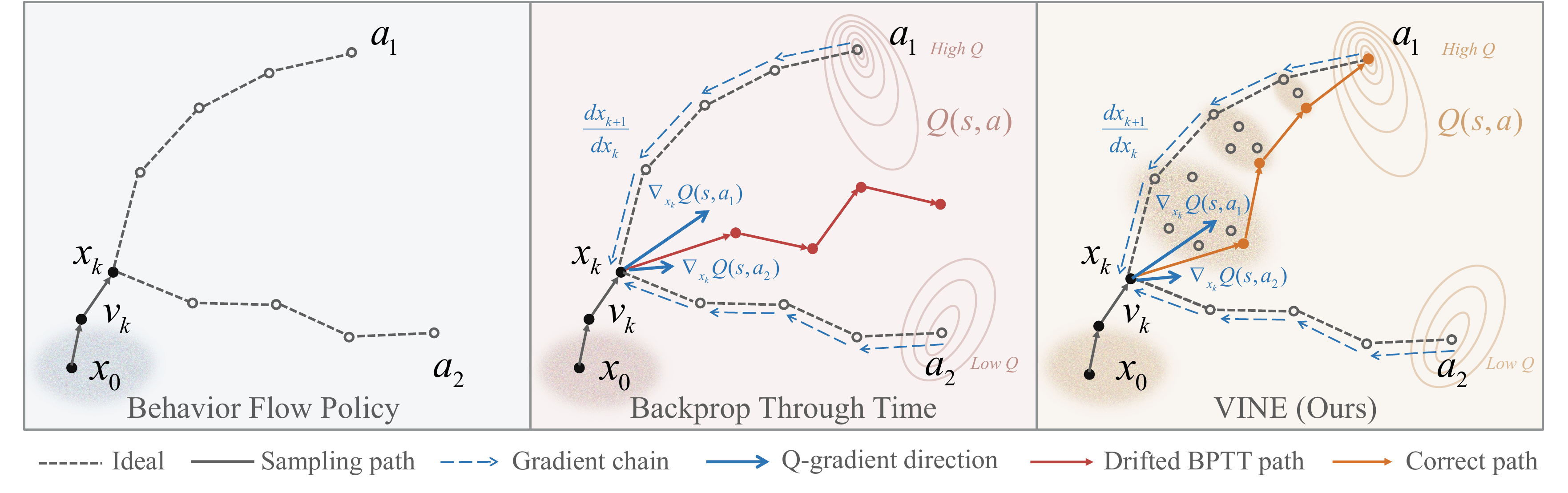
VINE reconstructs intermediate sampling states with fresh Gaussian noise, while propagating value gradients through the full iterative generation chain.
Algorithm
- Reconstruct and refine. VINE reconstructs each intermediate state from the current endpoint estimate and fresh Gaussian noise, then predicts the next endpoint with the flow-matching velocity network.
- Keep the sampling budget. Each action uses exactly K velocity-network evaluations, matching Euler at the same step count. The network architecture is unchanged.
- Optimize through the full chain. The critic fits Bellman targets using VINE-generated next actions. Actor updates propagate value gradients through every sampling transition, with behavior regularization when used.
- Reuse pretrained policies. VINE uses the existing flow-matching velocity field without an additional prediction network. A frozen-checkpoint evaluation on LIBERO-10 tests this compatibility empirically.
Click to see the full algorithm
VINE: Actor-Critic Training. Here, s and a are the environment state and action, xk is the intermediate sampling state, and K is the number of velocity-network evaluations. The hat denotes an action-endpoint estimate.
- function Generate(s)
- a0 ∼ N(0, Id)
- for k = 0, …, K − 1 do▹ Iterative generation
- tk ← k/K
- xk+1 ← xk + 1/K vθ(xk, tk; s)▹ Euler update
- zk ∼ N(0, Id)▹ VINE update
- xk ← tk ak + (1 − tk) zk
- ak+1 ← xk + (1 − tk) vθ(xk, tk; s)
- end for
- return aK
- end function
- while not converged do
- Collect transitions with Generate(s) and add to D▹ Optionally for online RL
- Sample batch {(s, a, r, s′)} ∼ D
- a′ ← Generate(s′)
- Update φ to minimize E[(Qφ(s, a) − r − γ Qφ̄(s′, a′))2]▹ Train critic Qφ
- aK ← Generate(s)
- Update θ to minimize −Qφ(s, aK) + α‖aK − a‖2▹ Train velocity vθ via BPTT
- end while
- return policy πθ(s) ≡ Generate(s)
Terminal critic targets retain the observed reward and omit the next-state value term. During actor updates, critic parameters are fixed while their action gradients pass through every endpoint prediction and reconstruction; no intermediate state is detached.
Toy Simulation: BC vs. RL
We compare DDPM, Euler flow matching, and VINE on a two-dimensional five-mode action distribution with different rewards. The first row shows behavior-cloned policies; the second shows offline RL fine-tuning with a learned critic. In the paper, DDPM and Euler flow matching eventually produce increasingly large off-target actions, whereas VINE retains concentrated endpoints while shifting toward the highest-reward mode. The appendix additionally reports direct optimization of a known reward without a learned critic.
| Training | DDPM | Flow Matching (Euler) | VINE |
|---|---|---|---|
| BC |
|
|
|
| RL |
|
|
|
Experiments
Real-World Experiments
Real-world manipulation with VINE, from precise insertion to dual-arm and tabletop tasks.
Online Real-World Socket Insertion
The robot must pick up a plug from the table and insert it into a fixed socket. All methods use images and proprioceptive observations to predict low-level actions or action chunks; human operators may intervene and provide corrective actions during online training. After 20 minutes of online RL, VINE succeeds in 20/20 evaluation trials and has a 19.2% human-intervention ratio.
Real-World Rollout Comparison
Selected VINE successes and baseline failures on socket insertion. These clips illustrate behavior; the table below reports success over 20 evaluation trials per method.
VINE Success Cases
Baseline Failure Cases
Online Learning with Human Feedback
This recording shows VINE training on real-world socket insertion. A human operator can intervene during autonomous execution and provide corrective actions. The evaluation below reports task success, online training time, and intervention frequency separately.
| Protocol | Setting |
|---|---|
| Task | Pick up a plug and insert it into a fixed socket. |
| Observations | Images and proprioceptive states. |
| Actions | End-effector control. |
| Human feedback | Corrective actions during online rollouts. |
| Evaluation | 20 trials per method after the listed training budget. |
| Method | Success (↑) | Online RL time | Human intervention (↓) |
|---|---|---|---|
| BC init. | 10/20 | -- | -- |
| DSRL | 17/20 | 50 min | -- |
| RLT | 17/20 | 50 min | 29.7% |
| EXPO | 19/20 | 50 min | 56.3% |
| SAC-Flow | 12/20 | 20 min | 74.6% |
| HIL-SERL | 16/20 | 20 min | 55.9% |
| VINE | 20/20 | 20 min | 19.2% |
Success is measured over 20 evaluation trials. Human-intervention ratio is the fraction of online rollout steps under human control. Training times are the reported evaluation budgets, not times to a common convergence threshold. A dash denotes an unreported or inapplicable entry.
Multi-Task Online RL with a Pretrained VLA
We adapt the 3B-parameter π0.5 VLA on LIBERO-10, LIBERO-Spatial, LIBERO-Object, and LIBERO-Goal, each with ten tabletop manipulation tasks. All variants share the same few-shot SFT initialization and differ only in the sampler: deterministic ODE, stochastic SDE, or VINE. In the evaluated setting, VINE yields more consistent policy improvement, while the ODE and SDE variants are unstable during multi-task fine-tuning. Each curve reports success averaged over the ten tasks in its suite.
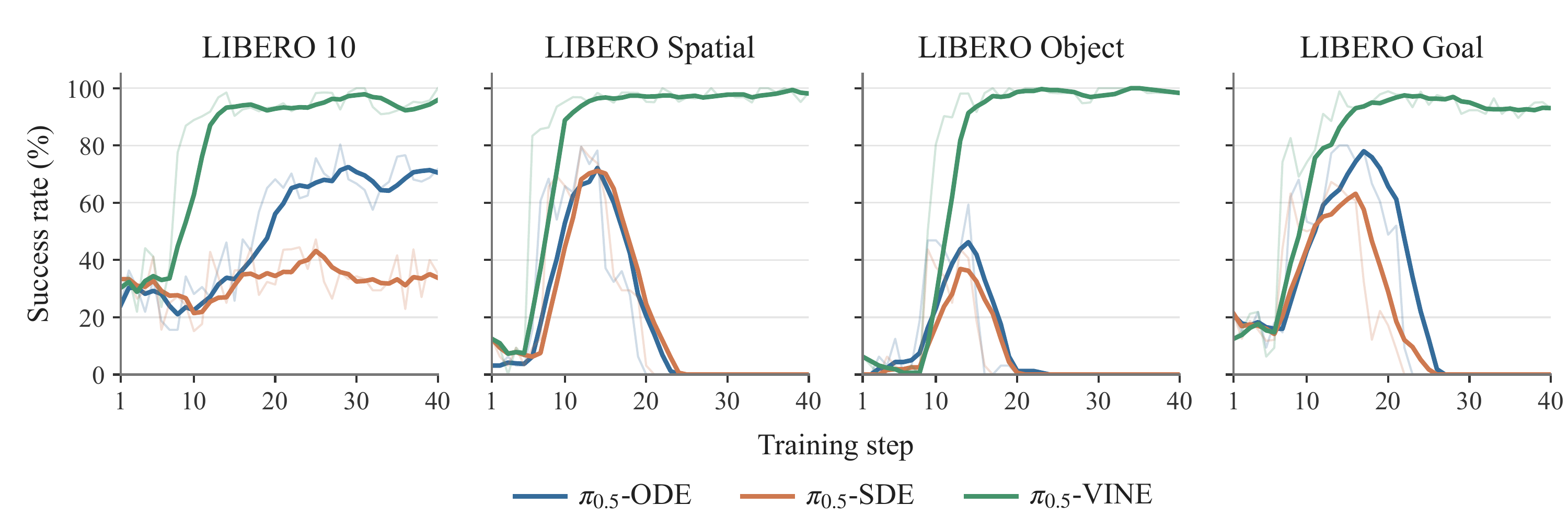
In a separate frozen-checkpoint evaluation on LIBERO-10, Euler and VINE achieve 44.34% and 45.26% success, respectively, across ten evaluation seeds with 500 episodes per seed and sampler. These similar observed rates provide empirical evidence that the pretrained flow-matching checkpoint can be directly reused with VINE.
Offline RL on OGBench
We evaluate 50 state-based tasks across ten OGBench domains, spanning long-horizon navigation and sparse-reward manipulation. Each task is trained for 1M gradient updates with 12 random seeds; results report mean success with 95% confidence intervals.
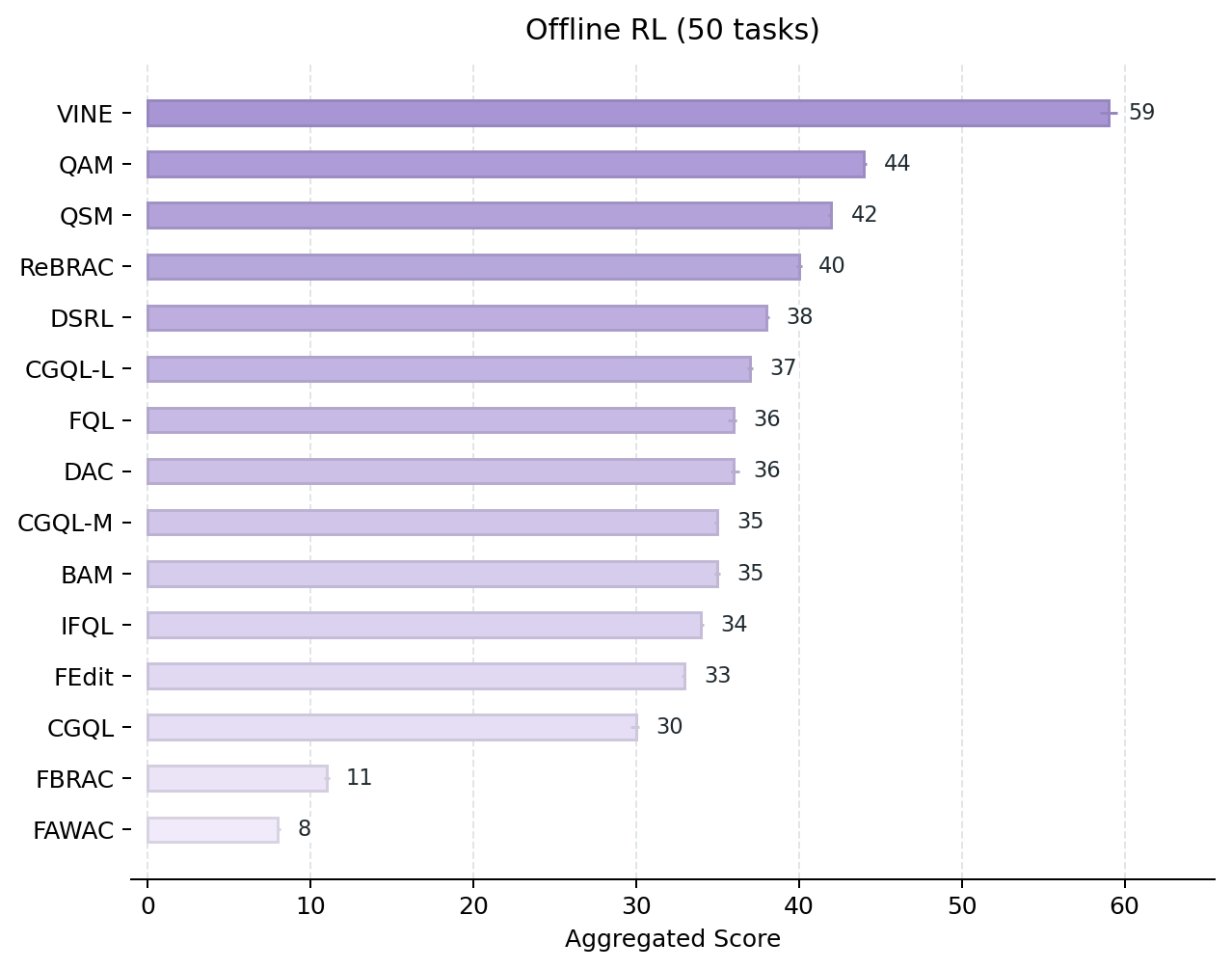
Click to expand offline results across 10 domains (50 tasks)
Offline results, 10 domains. Domain-level and overall mean success (%) with 95% confidence intervals in brackets, as reported in the paper. Each domain contains five tasks, with 12 training seeds per task. BPTT-free methods avoid propagating value gradients through the full sampling chain; Value-Gradient BPTT methods retain this optimization path.
| Task category | Gaussian | BPTT-free | Value-Gradient BPTT | ||||||||||||
|---|---|---|---|---|---|---|---|---|---|---|---|---|---|---|---|
| ReBRAC | FQL | FAWAC | IFQL | QAM | DAC | QSM | CGQL | CGQL-M | CGQL-L | DSRL | FEdit | FBRAC | BAM | VINE | |
| antmaze-large | 94 [94, 95] | 76 [72, 79] | 17 [15, 19] | 36 [32, 39] | 81 [78, 84] | 88 [86, 90] | 91 [89, 93] | 76 [73, 80] | 71 [68, 73] | 65 [62, 67] | 61 [56, 66] | 58 [53, 62] | 2 [1, 4] | 84 [82, 85] | 99 [98, 100] |
| antmaze-giant | 57 [53, 60] | 0 [0, 0] | 0 [0, 0] | 1 [0, 2] | 18 [14, 22] | 16 [11, 21] | 15 [11, 17] | 0 [0, 2] | 4 [1, 8] | 3 [1, 6] | 3 [1, 4] | 2 [1, 3] | 0 [0, 0] | 1 [0, 2] | 76 [68, 83] |
| humanoidmaze-medium | 69 [65, 74] | 68 [63, 73] | 24 [22, 26] | 86 [85, 87] | 67 [64, 69] | 83 [81, 85] | 83 [80, 86] | 60 [57, 62] | 42 [40, 43] | 62 [57, 67] | 53 [48, 57] | 22 [20, 23] | 39 [37, 41] | 60 [58, 62] | 87 [79, 93] |
| humanoidmaze-large | 17 [15, 20] | 9 [7, 11] | 0 [0, 0] | 24 [21, 27] | 11 [9, 14] | 0 [0, 0] | 10 [9, 11] | 5 [4, 5] | 6 [3, 8] | 6 [5, 8] | 3 [2, 5] | 3 [2, 3] | 0 [0, 0] | 5 [4, 8] | 46 [36, 56] |
| scene-sparse | 65 [61, 69] | 78 [77, 80] | 38 [35, 41] | 84 [83, 85] | 97 [96, 98] | 68 [65, 70] | 86 [84, 87] | 38 [36, 40] | 74 [72, 76] | 88 [85, 91] | 99 [99, 100] | 62 [60, 65] | 50 [43, 57] | 98 [97, 99] | 73 [60, 85] |
| puzzle-3x3-sparse | 79 [73, 84] | 70 [60, 78] | 3 [2, 3] | 100 [100, 100] | 100 [99, 100] | 68 [62, 75] | 53 [49, 57] | 48 [39, 55] | 100 [100, 100] | 90 [83, 96] | 87 [82, 92] | 99 [98, 100] | 0 [0, 1] | 56 [48, 64] | 95 [93, 97] |
| puzzle-4x4-100M-sparse | 0 [0, 0] | 5 [3, 7] | 0 [0, 0] | 0 [0, 0] | 0 [0, 0] | 0 [0, 0] | 0 [0, 0] | 24 [16, 33] | 0 [0, 0] | 0 [0, 0] | 0 [0, 0] | 34 [30, 37] | 15 [12, 19] | 0 [0, 0] | 28 [20, 35] |
| cube-double | 9 [8, 10] | 46 [43, 49] | 2 [2, 2] | 11 [10, 12] | 64 [62, 66] | 35 [33, 36] | 56 [53, 58] | 38 [36, 41] | 41 [39, 43] | 45 [43, 47] | 74 [72, 76] | 40 [37, 43] | 0 [0, 0] | 47 [44, 50] | 35 [29, 41] |
| cube-triple | 1 [0, 1] | 3 [2, 4] | 0 [0, 0] | 0 [0, 0] | 3 [3, 4] | 5 [3, 6] | 3 [3, 4] | 8 [7, 9] | 8 [7, 9] | 8 [7, 9] | 1 [1, 2] | 2 [2, 3] | 0 [0, 1] | 3 [2, 5] | 6 [4, 7] |
| cube-quadruple-100M | 9 [6, 11] | 2 [1, 4] | 0 [0, 0] | 2 [1, 3] | 3 [2, 4] | 3 [1, 5] | 19 [19, 20] | 0 [0, 0] | 1 [0, 1] | 0 [0, 1] | 2 [2, 3] | 5 [3, 7] | 0 [0, 0] | 0 [0, 0] | 47 [38, 56] |
| all (50 tasks) | 40 [39, 41] | 36 [34, 37] | 8 [8, 9] | 34 [34, 35] | 44 [44, 45] | 36 [35, 38] | 42 [41, 42] | 30 [28, 31] | 35 [34, 35] | 37 [36, 38] | 38 [38, 39] | 33 [32, 33] | 11 [10, 12] | 35 [34, 36] | 59 [56, 62] |
Citation
@misc{yang2026vinetaminggenerativecontrol,
      title={VINE: Taming Generative Control Policies for Reinforcement Learning},
      author={Rushuai Yang and Zhuo Han and Houlin Li and Rui Zhang and Hecheng Wang and Zhichao Wu and Zhaowei Zhang and Zihong Chen and Xiaohan Yan and Chuankang Li and Guanghui Ren and Chiming Liu and Yi Chen and Wei Shan and Maoqing Yao},
      year={2026},
      eprint={2607.10369},
      archivePrefix={arXiv},
      primaryClass={cs.RO},
      url={https://arxiv.org/abs/2607.10369},
}